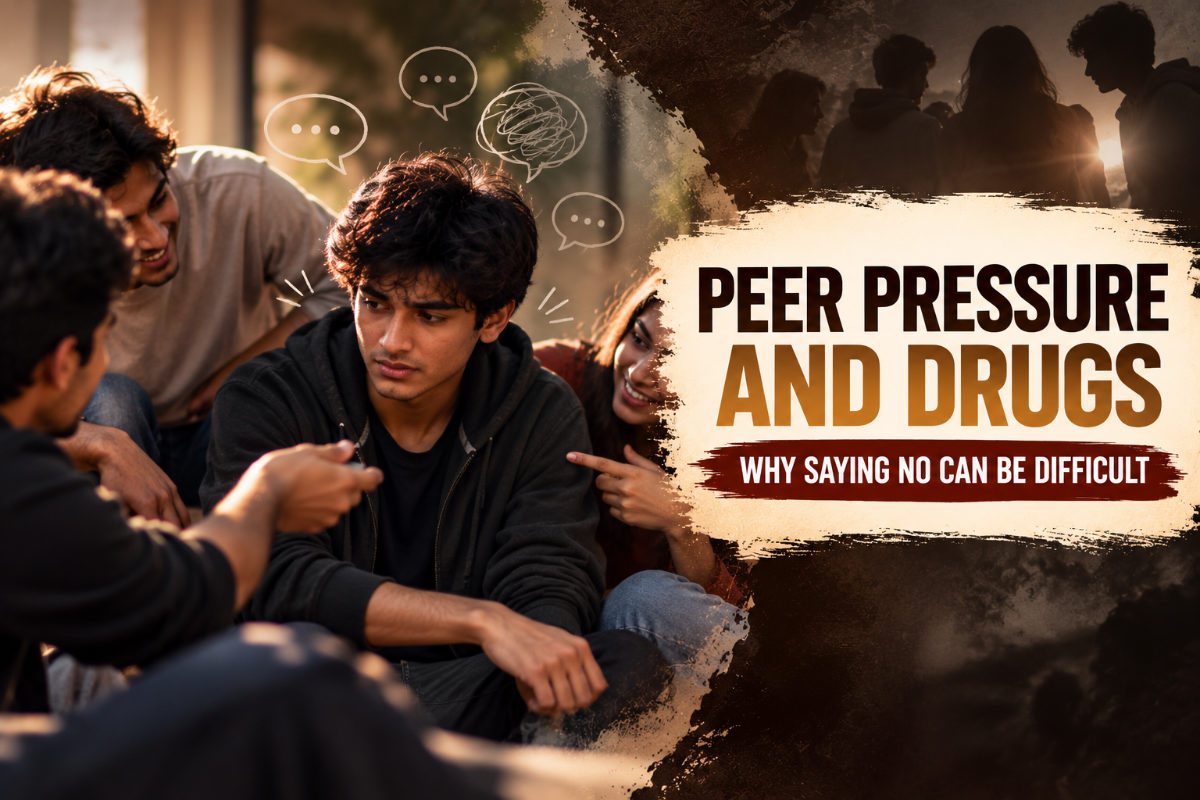
For many young people, friends, social groups and the need to feel accepted can strongly influence everyday decisions. When it comes to drugs and substance use, peer pressure can make saying no difficult—especially when trying something is presented as normal, harmless or simply something “everyone” is doing. Research involving adolescents in India has identified peer influence, curiosity, stress and the desire for social acceptance among factors associated with starting or continuing drug use. Understanding how peer pressure works, why young people can be particularly sensitive to it, and how to respond confidently can help make healthier choices easier.
What Does Peer Pressure Actually Mean?
Peer pressure is often imagined as someone directly saying:
- “Try this. Everyone else is doing it.”
But it is not always that obvious.
Peer pressure can also be subtle. A young person may feel that they need to behave like their friends to fit in, avoid being judged, maintain friendships or feel included.
It can look like:
- Being encouraged to try drugs at a party.
- Feeling uncomfortable because everyone else in the group is using something.
- Being called “boring” for refusing.
- Feeling that saying no will affect friendships.
- Being told that trying something once is harmless.
- Seeing drug use repeatedly within a social group and gradually considering it normal.
Research with adolescents in India has found that peer influence can be connected with drug experimentation and continued use, particularly when drug use becomes associated with belonging and acceptance within a peer group.
Why Does Peer Pressure Matter So Much to Young People?
Adolescence and young adulthood are periods when people are developing their identity, becoming more independent and building stronger relationships outside the family.
WHO notes that adolescence is a period of major social, emotional and cognitive development, during which young people establish patterns of behaviour that can influence their health later in life. Supportive relationships, life skills and safe environments can play an important protective role.
For many young people, being accepted by their peers can feel extremely important.
That does not mean young people are incapable of making their own decisions. It means that social belonging is a powerful part of growing up, and situations involving friends can sometimes make decisions more complicated.
Peer Pressure is Not Always Direct
One of the most important things to understand is that peer pressure does not always involve someone forcing another person to use drugs.
Direct pressure
This is when someone openly encourages another person to try a drug.
For example:
- “Come on, just try it once.”
Indirect pressure
This happens when a person feels pressure simply because everyone around them is doing something.
For example:
- “Everyone in our group does it. I don’t want to be the only one saying no.”
The pressure to fit in
Sometimes nobody even asks a person to participate.
They may simply think:
- “If I don’t do this, will they stop including me?”
This fear of being left out can influence decisions, particularly when a group has already normalised risky behaviour.
A recent Government of India awareness article on drug prevention similarly highlights the social pressure young people can experience when saying no feels like stepping away from their peer group.
Why “Just Say No” is Not Always That Simple
Telling young people to “just say no” is easy advice to give, but real situations can be more complicated.
Imagine being at a gathering with people you want to impress or fit in with. Someone offers you a drug. Everyone around you appears comfortable with it.
In that moment, the decision may involve more than knowing that drugs can be harmful.
A person may also be thinking:
- “Will they make fun of me?”
- “Will I look different?”
- “Will they stop inviting me?”
- “What if I lose my friends?”
- “Maybe it really isn’t a big deal.”
- “I don’t want to seem scared.”
Understanding these pressures is important because prevention is not simply about giving information. Young people also need social, emotional and decision-making skills that help them handle difficult situations. Evidence-based prevention approaches include strengthening social skills, family relationships and healthy coping strategies rather than relying only on fear-based messages.
Social Media Can Make the Pressure Feel Different
Peer influence today does not always stop when a young person leaves school, college or a social gathering.
Social media can make young people’s social environments feel continuous. They may constantly see what friends, influencers or wider social groups are doing, including content
that can make certain behaviours appear popular or normal.
However, it is important not to assume that social media directly causes drug use.
The bigger issue is how repeated exposure, social comparison, belonging and perceived norms can influence how young people understand what is considered acceptable within their social environment.
That makes media literacy and critical thinking important parts of youth prevention.
How Can You Handle Peer Pressure?
Knowing what you want to do before you are placed in a difficult situation can make it easier to respond.
Have a simple response ready
You don’t need to give a long explanation.
You can simply say:
- “No, I’m not interested.”
- “I’m good. I don’t want to.”
- “No thanks.”
A clear response does not need to become an argument.
Change the situation
If the pressure continues, you can:
- Move away from the situation.
- Go somewhere else with a trusted friend.
- Change the subject.
- Leave the gathering if necessary.
- Contact someone you trust.
Leaving a situation that makes you uncomfortable is not overreacting. It is a way of protecting your own boundaries.
Comments are closed.